
Geography & Environmental Studies Program
Graduating Seminar
Introduction
Wicked problems are complex social or policy issues inherently resistant to easy solutions. Unlike “tame” problems, they defy definitive formulation, lack clear stopping rules, and are subject to diverse, conflicting stakeholder values. Traditional, linear problem-solving methods often fail in such contexts.
In today’s rapidly changing world, recognizing and understanding wickedness is vital for students. The classical scientific or engineering paradigm, focused on efficiency, doesn’t apply. Instead, navigating these challenges requires systems thinking, iterative problem framing, an awareness of power dynamics, and the ability to acknowledge and learn from attempts that don’t produce perfect solutions. Further, professionals must recognize the inherent wickedness within any problem to avoid unethical premature quick fixes or applying tame frameworks to wicked problems.
Wicked Problem Systems Maps
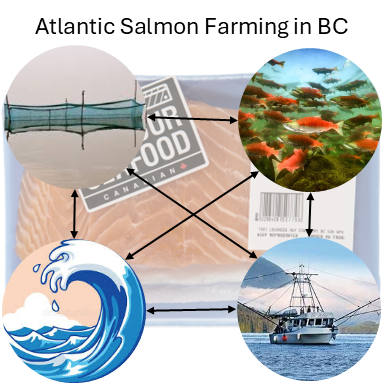
Systems maps are visual representations that illustrate the intricate web of relationships within a wicked problem. By mapping key elements, feedback loops, and causal connections, we can gain a more holistic understanding of the system’s behavior. These maps can then help identify potential leverage points – areas where small, well-placed interventions might create significant positive change, acknowledging the inherent uncertainties and potential for unintended consequences.
These systems maps exploring wicked problems have been developed by Geography and Environmental Studies students as part of their capstone work.